
How Grid Trading Works
A six-part visual guide to grid trading mechanics — from how the grid is built, to what happens when price trends out of it, to how CoinRoc decides when a grid should be deployed at all.
New to grids? Start with the quick primer →
How a Grid Is Built
Every grid strategy starts with a fixed structure: an upper bound, a lower bound, and a set of evenly spaced price levels in between. Every buy and sell order is placed automatically at setup — before any trade happens.
The Round-Trip Engine
Each grid level pairs a standing buy order with a standing sell order one level up. When price dips to the buy level and then recovers to the sell level, both sides fill — completing a round-trip and locking in the spread between the two levels.
Sideways Market: Where Grids Thrive
A grid is built to capture repeated oscillation, not a single directional move. As price crosses several levels going down and then back up, each crossing can complete its own round-trip.
The Grid-Walk Problem
A trending market is a grid's adversary. If price climbs steadily out of the upper bound — or falls through the lower bound — the strategy can accumulate inventory with no corresponding fills on the other side, and the round-trip engine stops turning. This is the direct counterweight to Step 3: a grid's performance depends heavily on whether the market stays range-bound.
Analyze Before You Deploy
Because grids depend on range-bound conditions, knowing the market regime before deploying capital matters. CoinRoc's analysis tooling checks regime, volatility, and range signals first, gating when a grid is configured versus when the system waits.
Journey Through the Grid
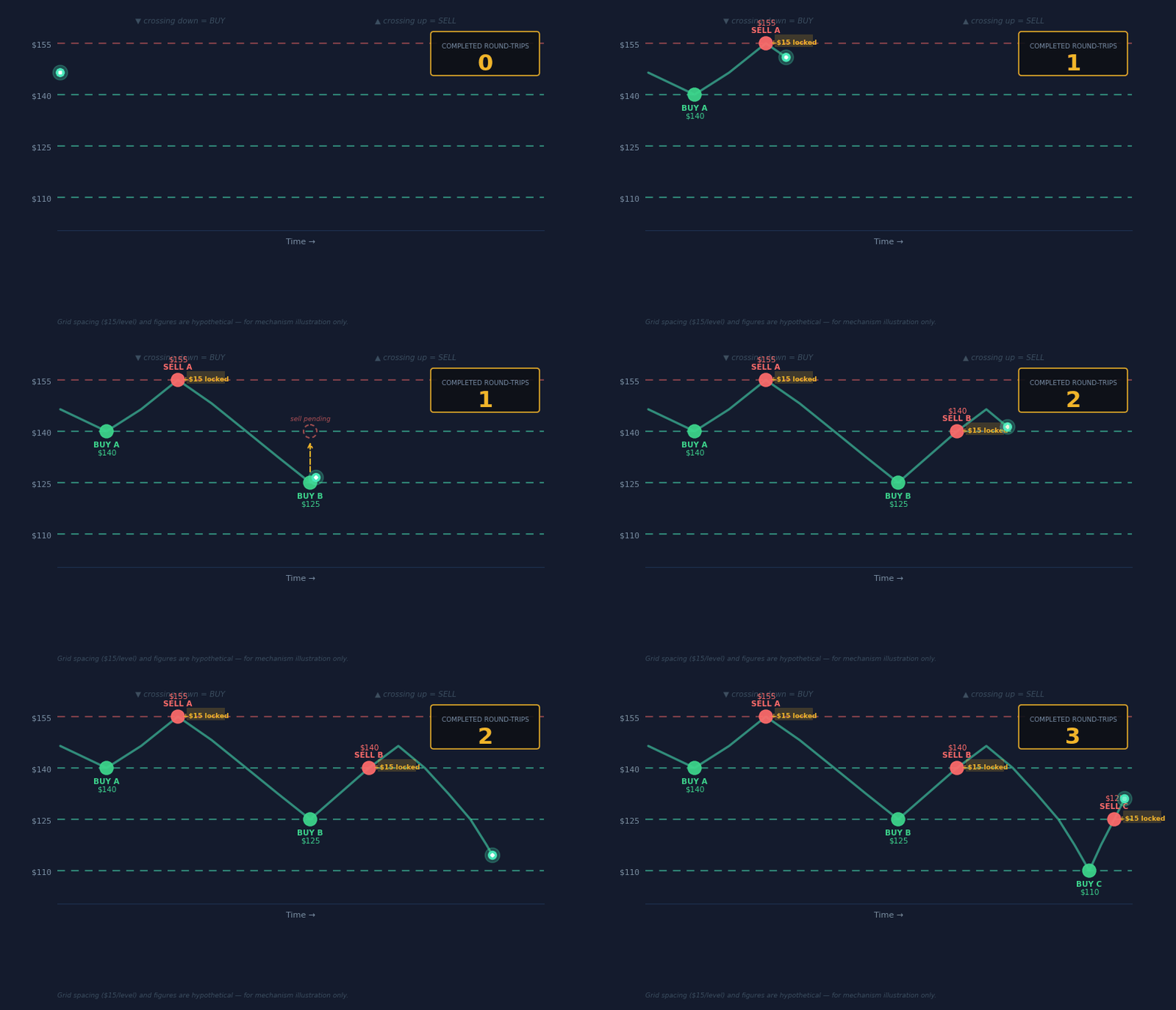
The mechanics above, animated: watch a price dot travel through the grid, triggering buy and sell fills as it crosses each level, with a running round-trip counter.
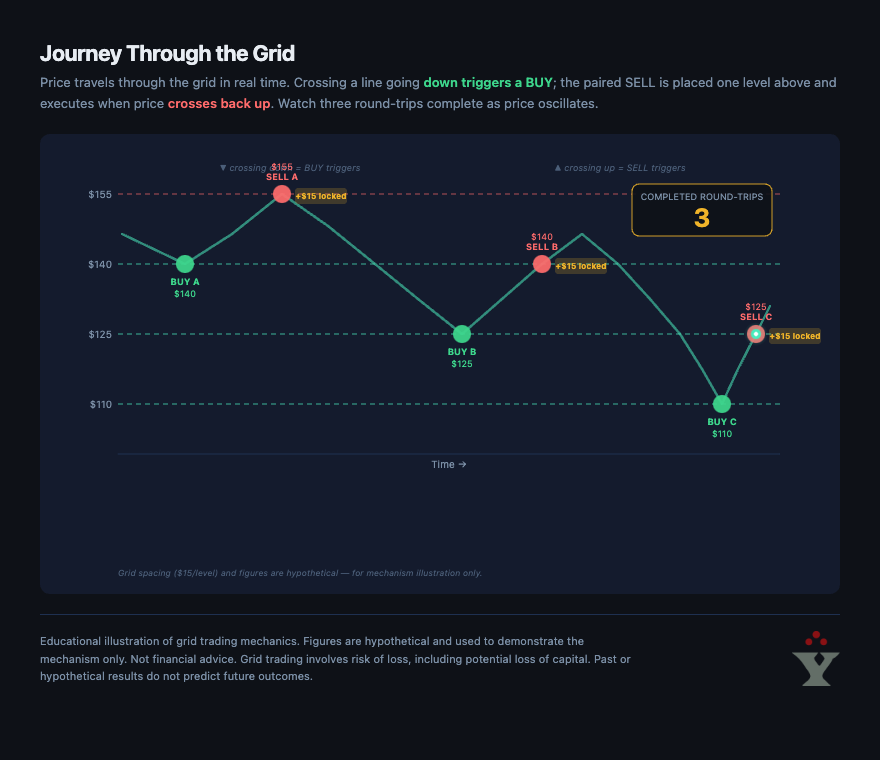
Animation not loading? View the GIF version
This page is for informational and educational purposes only. It does not constitute investment advice, a recommendation, or an offer or solicitation to buy or sell any security, digital asset, or financial instrument. All figures, prices, and dollar amounts shown throughout these illustrations are hypothetical and used solely to demonstrate how grid trading mechanics work — they are not backtested results, performance projections, or an indication of expected returns. Grid trading, like all trading strategies, involves risk, including the risk of loss of principal, particularly in trending markets where a grid strategy may accumulate unhedged inventory (see “The Grid-Walk Problem” above). Digital assets are highly volatile and may lose some or all of their value. Past or hypothetical performance is not indicative of future results. No analysis tool, including CoinRoc's, can guarantee profitable outcomes. Readers should consult their own financial, legal, and tax advisors before making any investment decision.